
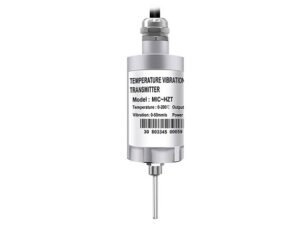
In equipment design, measuring the temperature of materials is a frequent requirement. Due to their simple structure, wide measurement range, and easily processed output signals, thermocouples have become the preferred sensors for temperature measurement.
A thermocouple is a passive sensor based on the principle of the thermoelectric effect. This effect occurs when a circuit is formed by joining two dissimilar conductors (known as thermocouple wires or electrodes) at both ends; when the two junctions are at different temperatures, an electromotive force (EMF) is generated in the loop. Consequently, different types of thermocouples are categorized based on the materials of the two wires, each having its own advantages, disadvantages, and application ranges.
Here are the specific details:

1. Type K (Nickel-Chromium / Nickel-Silicon)
The Type K thermocouple is currently the most widely used base-metal thermocouple, with its usage volume equaling the sum of all other types.
- Positive Leg (KP): Nominal chemical composition is Ni:Cr = 90:10.
- Negative Leg (KN): Nominal chemical composition is Ni:Si = 97:3.
- Operating Temperature: -200 to 1300°C.
- Advantages: Good linearity, large thermal EMF, high sensitivity, excellent stability and uniformity, strong oxidation resistance, and low cost. It can be used in oxidizing and inert atmospheres.
- Limitations: It cannot be used directly at high temperatures in sulfurous, reducing, or alternating oxidizing-reducing atmospheres, nor in a vacuum. It is also not recommended for weakly oxidizing atmospheres.

2. Type N (Nicrosil / Nisil)
- Positive Leg (NP): Nominal chemical composition is Ni:Cr:Si = 84.4:14.2:1.4.
- Negative Leg (NN): Nominal chemical composition is Ni:Si:Mg = 95.5:4.4:0.1.
- Operating Temperature: -200 to 1300°C.
- Characteristics: Its overall performance is superior to Type K.
- Limitations: It cannot be used directly at high temperatures in sulfurous, reducing, or alternating atmospheres, nor in a vacuum. It is also not recommended for weakly oxidizing atmospheres.
3. Type J (Iron / Constantan)
Also known as the Iron-Constantan thermocouple.
- Positive Leg (JP): Nominal composition is pure iron.
- Negative Leg (JN): Copper-Nickel alloy.
- Temperature Range: -200 to 1200°C, but typically used within 0 to 750°C.
- Applications: Can be used in vacuum, oxidizing, reducing, and inert atmospheres.
- Limitations: The iron leg oxidizes quickly at high temperatures, limiting the operating range. It cannot be used unprotected in sulfurous atmospheres at high temperatures.
4. Type E (Nickel-Chromium / Constantan)
Also known as the Nickel-Chromium-Constantan thermocouple.
- Positive Leg (EP): Ni-Cr 10 alloy (same as KP).
- Negative Leg (EN): Copper-Nickel alloy.
- Operating Temperature: -200 to 900°C.
- Advantages: Highest thermal EMF and sensitivity among standard types; ideal for measuring tiny temperature changes and high-humidity environments. Good stability and better oxidation resistance than Types T and J.
- Limitations: Not for high-temperature use in sulfurous or reducing atmospheres. Poor thermal EMF uniformity.
5. Type T (Copper / Constantan)
Also known as the Copper-Constantan thermocouple.
- Positive Leg (TP): Pure copper.
- Negative Leg (TN): Copper-Nickel alloy.
- Temperature Range: -200 to 350°C.
- Characteristics: Best stability in the -200 to 0°C range.
- Limitations: Poor oxidation resistance at high temperatures, limiting the upper usage limit.


? Noble Metal Thermocouples (Types R, S, and B)

Noble metal thermocouples offer high accuracy, superior stability, wide measurement ranges, long service life, and excellent high-temperature oxidation resistance. However, they have lower thermal EMF rates and sensitivity, reduced mechanical strength at high temperatures, are highly sensitive to contamination, and are expensive.
| Type 型号 | Positive Leg | Negative Leg | Max Temperature |
| Type R | Pt-Rh 13% | Pure Platinum | 1300°C (long) / 1600°C (short) |
| Type S | Pt-Rh 10% | Pure Platinum | 1300°C (long) / 1600°C (short) |
| Type B | Pt-Rh 30% | Pt-Rh 6% | 1600°C (long) / 1800°C (short) |
- Type B Advantage: It does not require compensation wires because its thermal EMF is less than $3\mu V$ in the 0 to 50°C range.